Technology Summary
In order to meet stringent zero liquid discharge (ZLD) requirements, environmentally conscience companies are turning to advanced technologies that eliminate wastewater streams and leave behind clean water and solid salt crystals.
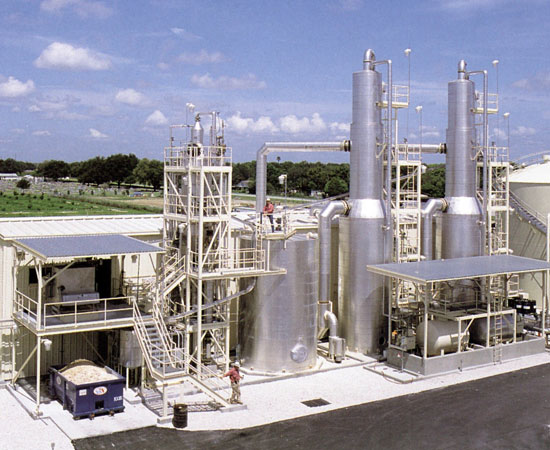
ZLD Crystallizer
Combined with other brine concentration technologies, such as EDR or RO, evaporators and crystallizers concentrate the wastewater to a solid that can be safely disposed of in a suitably accredited landfill or recovered as a valuable by-product for use.

Falling Film Brine Concentrator
Our ZLD technology is a skid-mounted, fully packaged system that includes auxiliary equipment and controls for ease of installation. It is customized for client specific valuable product recovery from saline effluent streams. The design has minimal energy consumption with mechanical vapour recompression (MVR) technology for steam vapour recycling. It also includes an automatic wash system to ensure ease of operation.

Forced Circulation Crystallizer
Technology Benefits
Our technology has the following main benefits:
– Corrosion resistant titanium—High grade construction materials mean brine concentrators will last for decades and provide reliable operation
– Scale control—Proprietary seeded slurry technology controls scale, often limiting cleanings to only once per year
– Patented brine distributors—Individual tube distributors ensure a smooth flow of brine, avoiding scale formation
– Variable waste flows—From 2,5 m3/h to 270 m3/h per train
– Energy-efficient operation—In the vapour compression configuration, the brine concentrator uses 13 to 24 kWh/m3 of feed, which is 25 to 50 times more efficient than conventional single-effect, steam-driven evaporators
– Ability to run on electricity or steam—Typical operation is by mechanical vapour compression, but brine concentrators may also run on steam in a multiple-effect configuration
– Fully automated operation—Maintain precise system control while minimizing operator interaction
Applications
ZLD technology has been implemented in a wide range of applications where saline liquid effluent streams could not be discharged to the environment, such as:
– Battery Manufacturing
– Coal & Uranium Mining
– Coal liquefaction
– Chemical
– Cogeneration
– Petroleum & Petrochemical
– Ethanol Production
– Primary metals processing
– Solid waste (leachate and secondary sewage effluent)
– Synthetic fuels
– Microelectronics
– Pulp & Paper
– PVC Manufacturing
– SAGD heavy oil recovery
– Fertilizer
– Oil Refining
– Power Generation
Video
Watch a video clip on our Zero Liquid Discharge technology: